Note: This article is for general information purposes and does not replace individual dental advice.
What is tartar?
Having tartar removed can help to prevent tooth decay. Tartar is a deposit that forms on the tooth surface and becomes firmly attached to it. It consists largely of hydroxyapatite, proteins, carbohydrates, minerals such as whitlockite or brushite, as well as microorganisms and tissue residues. The areas around the lower front incisors and the outer surfaces of the upper molars are particularly susceptible. The reason for this is the increased flow of saliva at these points in the mouth. Bacteria attach themselves to the teeth after just 4 hours. Tartar is visible and can also be felt with the tongue.
How does tartar form and how can it be prevented?
Tartar develops primarily as a result of inadequate oral hygiene. If the saliva contains high levels of inorganic substances, these are deposited in what is known as plaque. Plaque is a soft film that settles on the teeth. If the plaque remains there for a longer period, it hardens through a chemical reaction and turns into tartar. This development takes place in 4 phases.
Around 4 hours after brushing, a thin layer settles over the tooth enamel. At this stage, however, it is still free of bacteria. If food debris enters the mouth, the caries-causing bacteria multiply and coat the thin layer on the tooth enamel.
After some time, plaque then forms. If it remains on the teeth, it takes between 8 and 10 days for mineralisation to set in and tartar to develop. Tartar can, however, also be prevented effectively.
Anyone who brushes their teeth regularly — at least in the morning and evening — and thoroughly removes the precursor of tartar: plaque. Cleaning the spaces between the teeth, as well as using mouthwash and a tongue cleaner, also removes the bacteria and germs from the mouth that are responsible for tartar formation and helps to prevent tartar.
Electric toothbrushes are particularly effective. They remove dental plaque especially thoroughly. The toothpaste should also contain fluoride, as this has the ability to repair tooth enamel that has already been attacked. Brushing itself should take at least 2 minutes — ideally 3 minutes. A small brush head with plastic bristles is ideal. Closely spaced teeth can also encourage tartar. These areas need to be cleaned particularly thoroughly, or orthodontic correction may even be required.
A professional teeth cleaning by dentist Dr. Pantas should also be carried out at least once a year. This helps to prevent tartar.
To what extent can tartar be harmful to teeth and gums?
The build-up of tartar can lead to gum inflammation. This is not only painful, it also promotes the development of periodontal disease. Infections can spread from here to the entire mouth. The risk of tooth decay also increases. If an implant is already present in the mouth, tartar can cause inflammation there as well. The result is what is known as peri-implantitis, which affects the entire implant.
What can influence the formation of tartar?
Oral hygiene is decisive in determining whether, and to what extent, tartar develops. Diet, however, is also an important factor and can contribute to tartar forming. A diet rich in carbohydrates encourages tartar formation, as the harmful bacteria feed on precisely these carbohydrates. Sugar in particular is pure poison for the teeth. Smoking is a further risk factor for tartar formation.
Removing tartar
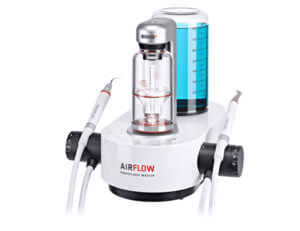
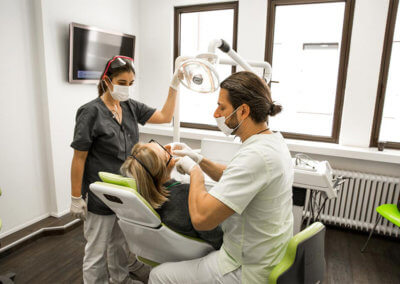
Even if all these tips are followed, tartar can still develop over time. A visit to the dentist in Düsseldorf is then essential. The dentist has the necessary instruments to remove tartar effectively. As a rule, he grinds it off the teeth or carefully breaks it away, using specialised instruments. This is also done as part of a professional teeth cleaning, which dentist Dr. Pantas carries out on request.
Removing tartar yourself and counteracting it effectively
There are, however, also ways of tackling tartar yourself at home. One well-known remedy is baking powder, or bicarbonate of soda. It is highly alkaline and neutralises acids present in the mouth. The powder can be applied directly to the toothbrush together with the toothpaste.
The teeth are then brushed as usual. Discolouration can also be loosened in this way, leaving the teeth looking whiter afterwards. Baking powder can also be added to mouthwash, where it simply neutralises the acids. This home treatment should not be used too often, as damage to the tooth enamel can otherwise occur.
Tea tree oil, thanks to its antibacterial effect, is also well suited to combating tartar formation. The oil is likewise applied to the toothbrush or added to mouthwash. Another home remedy is lemon. The fruit acid specifically kills germs in the mouth. Although lemon juice cannot dissolve tartar directly, it can counteract the formation of plaque and help to prevent tartar. Here too, however, the treatment should not be used too often, as the tooth enamel can suffer as a result.
The same applies to vinegar, including cider vinegar. Those who feel confident enough can also use a so-called dental scaler. This instrument is also used by dentist Dr. Pantas. A certain amount of practice and expertise is required here, however, to avoid causing damage. The scaler has a pointed hook that breaks up the tartar and detaches it from the tooth. A so-called tartar eraser has also recently come onto the market, removing tartar by means of a rubber coating made of carborundum or natural rubber. Curettes can also remove tartar, particularly from the gum pockets. Handling this instrument, however, likewise requires considerable experience and is not entirely without risk for the teeth. There are also electric sonic toothbrushes, which remove plaque from the teeth particularly effectively and thus help to prevent tartar.
Recognising tartar: before and after
Tartar is usually visible as a yellowish-brown or whitish deposit on the inside of the lower incisors or on the outer surfaces of the upper molars. It feels rough and, unlike soft plaque, cannot be removed by brushing. After a professional teeth cleaning, the teeth are smooth and clean — the difference is often clearly visible and noticeable.
Having tartar removed at the dentist
The safest and most effective way to remove tartar is to have it removed professionally at the dentist. At our practice in Düsseldorf, we use modern ultrasonic instruments that gently detach the tartar from the tooth surface without damaging the enamel. Most patients find tartar removal unpleasant but quite bearable, and for patients with statutory health insurance it is covered by the health insurance fund once a year.
As part of a professional teeth cleaning, not only tartar is removed, but also soft plaque in hard-to-reach areas, discolouration and bacteria. We recommend a professional teeth cleaning once or twice a year.
Frequently asked questions about tartar
How often should you have tartar removed?
Does tartar removal hurt?
Can you remove tartar yourself?
How quickly does tartar build up again?
What happens if tartar is not removed?

This article is for general information purposes and does not replace professional dental advice. If you have symptoms, please contact your dentist.