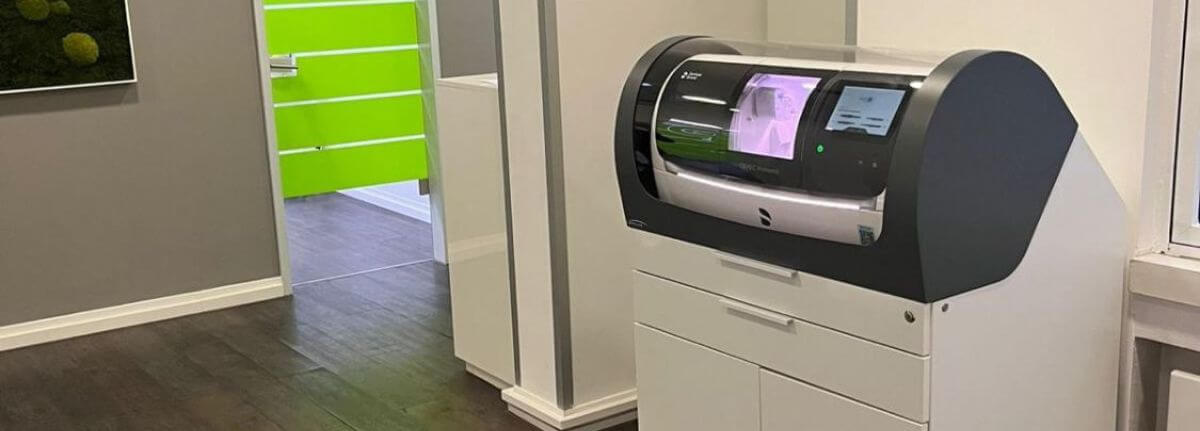
When dental prosthetics are needed, many patients wish for treatment that is predictable and as time-saving as possible. CEREC offers a digital procedure for this purpose, allowing certain ceramic restorations to be designed and produced directly at the practice in suitable cases.
What is CEREC?
CEREC stands for CEramic REConstruction and refers to a computer-assisted method for producing dental restorations. Using CAD/CAM technology (Computer-Aided Design/Computer-Aided Manufacturing), restorations can often be completed within a single appointment, depending on the clinical findings. Whether this is possible depends on the type of defect, the choice of material and the clinical situation. In appropriate cases, this can reduce the need for additional appointments or temporary interim solutions.
How does CEREC work?
The CEREC process consists of several coordinated steps:
Capturing the digital data: To begin with, the affected tooth is scanned with a special intraoral camera. Unlike conventional impressions taken with impression material, the data is captured digitally. The scan creates an accurate 3D representation of the tooth and its surroundings.
Digital design: The data obtained is transferred to a CAD program. There, the restoration is designed and adapted to the individual situation, taking both functional and aesthetic aspects into account.
Producing the restoration: The next step is the fabrication of the restoration. Using a special CAD/CAM milling unit, the planned restoration is milled from a ceramic block. Depending on the type of restoration, this process often takes only a few minutes.
Try-in and fitting: Once the restoration has been milled, it is fitted in the mouth. Among other things, we check the shape, contact points and bite. Depending on the situation, minor adjustments — or, in individual cases, a further appointment — may be advisable.
The advantages of CEREC
CEREC offers several advantages for suitable indications:
Speed and predictability: In appropriate cases, the restoration can be completed within a single session. This reduces waiting times and temporary interim solutions.
Precision and accuracy of fit: The digital scan and computer-assisted design allow a very precise adaptation to the individual situation. Whether any adjustments are needed, however, always depends on the individual case.
Aesthetics and material quality: The restoration is frequently made of ceramic material, which often blends naturally into the dentition in terms of colour and shape. How long a restoration lasts depends, among other things, on the indication, the material and how well it is cared for.
No conventional impression: Many patients find traditional impressions with impression material unpleasant. With CEREC technology, the data is captured digitally.
Reduced treatment time: If the clinical findings and the restoration are suitable for CEREC, the overall process can be shorter than with conventional methods.
When is CEREC appropriate?
CEREC can be appropriate for various types of restoration, including:
Crowns: If a tooth is severely damaged, a CEREC crown can stabilise it and restore its function.
Inlays and onlays: For smaller tooth defects, CEREC inlays or onlays can replace lost tooth structure.
Veneers: In aesthetic treatments, veneers made of CEREC ceramic can be used where the clinical findings and the treatment goal are suitable.
Bridges: Certain gaps between teeth can also be restored with a CEREC bridge. Whether this is the right solution in an individual case is something we assess beforehand, based on the clinical findings, the load on the teeth and the choice of material.
CEREC at the Dr. Pantas dental practice
At our Dr. Pantas dental practice, we use CEREC as part of modern digital dentistry. The procedure complements our range of services wherever chairside treatment is medically appropriate. Many patients appreciate the digital scan, the short production time and the close coordination between design and try-in.
Whether it is a crown, an inlay or another ceramic restoration: we assess in advance whether CEREC is suitable for your situation, and we discuss alternatives, the treatment process and the costs transparently.
What we discuss with you beforehand
Whether CEREC is the right solution depends on the clinical findings, the load on the tooth, the choice of material and your aesthetic wishes. Before treatment begins, we explain the indication, possible alternatives and the expected scope of treatment.
This gives you a realistic assessment of whether treatment within a single appointment is possible, or whether a different approach is medically more appropriate.
Conclusion: CEREC as a digital restoration in a short time
In suitable cases, CEREC can enable a time-saving and precise treatment with ceramic restorations. Whether treatment within a single appointment is realistic depends on the individual clinical findings. If you would like to know whether CEREC is an option for you, we will be happy to advise you in person.